
 By Christian Hayes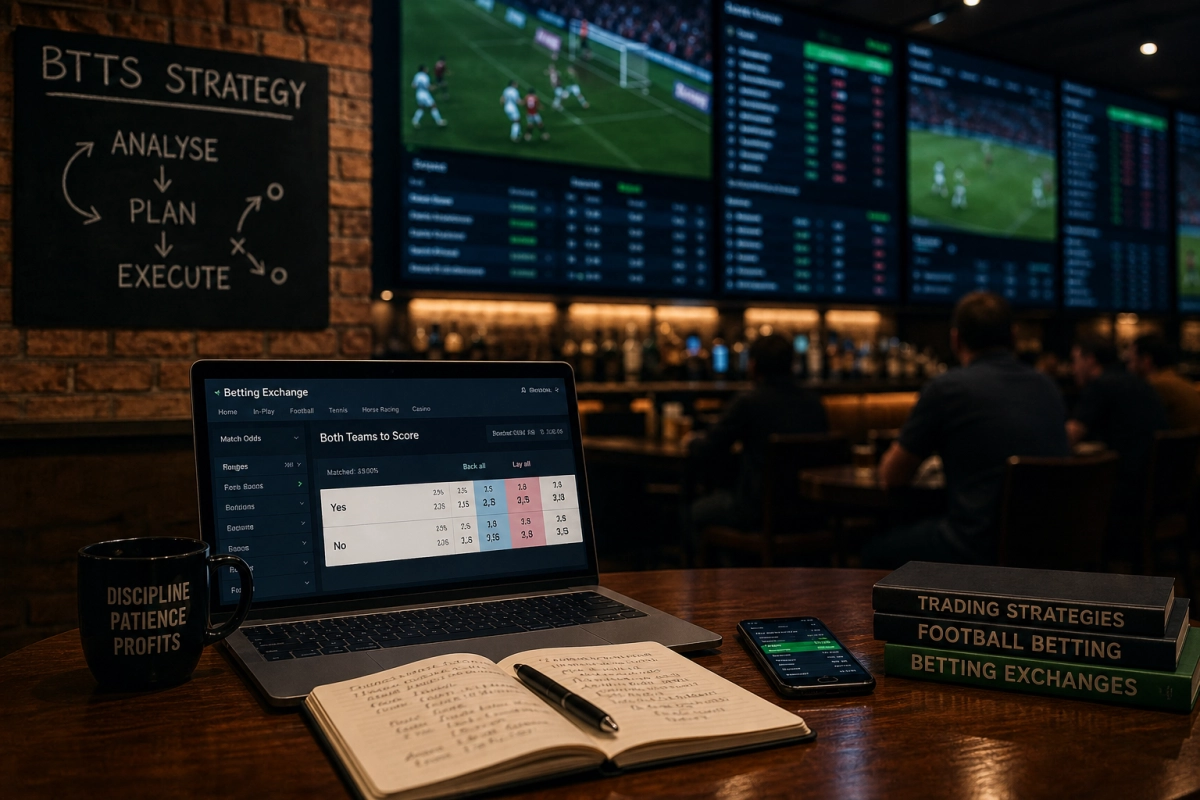
How to approach the both teams to score market before kick-off
What the both teams to score market is and why traders use it
The both teams to score (BTTS) market asks a simple question: will both teams score at least one goal? On betting exchanges this market can be traded — backed (betting yes) or laid (offering yes) — and positions can be closed before full-time by taking the opposite side. Traders like BTTS because it’s a binary, event-driven market with clear in-play triggers and widely available statistics to inform decisions.
Advantages include frequent opportunities, relatively stable liquidity on popular matches, and the ability to hedge or lock profits in-play. Risks include sudden game events (red cards, injuries), low-liquidity matches with wide spreads, and the possibility of volatile odds near kick-off and after goals.
Pre-match selection: data, context and market timing
Successful BTTS trading begins long before the whistle. Pre-match selection narrows the field to matches with tradable characteristics.
Key selection criteria
- Recent goals data: both teams’ goals scored and conceded across last 6–10 matches and home/away splits.
- Expected goals (xG): teams with higher xG for and against are likelier to produce goals.
- Playing style and tactics: attacking teams or those with high pressing tendencies often create returns for BTTS traders.
- Team news: injuries, suspensions, or rotated lineups that weaken attack or defence.
- Motivation and context: end-of-season, cup-deciders, or congested schedules can affect lineups and intensity.
- Market liquidity and odds: avoid obscure leagues with thin markets; check exchange volume and bid/ask spreads.
When to enter a pre-match trade
Timing matters. Many traders place pre-match trades 1–3 hours before kick-off when markets settle after team sheets are confirmed. Others wait until 10–20 minutes prior to exploit late price moves. Pre-match backing and laying can be used to create a small, near-certain profit or to set up a favoured position for in-play trading.
Worked example: pre-match stake and liability calculations
Concrete numbers clarify how backing and laying work on exchanges. The following example uses fictional teams and round figures.
Example A — Back BTTS pre-match
Match: United A vs City B. Exchange odds for BTTS “Yes”: 1.90. Backer stakes £100.
- If both teams score: Return = £100 × 1.90 = £190 (profit £90).
- If one or no team scores: Loss = £100 (stake lost).
Example B — Lay BTTS pre-match
Same match, trader lays BTTS “Yes” at 2.50 with a lay liability set by the trader. If they choose a lay stake of £40, liability = (odds – 1) × lay stake = 1.50 × £40 = £60.
- If both teams score: Lay liability paid = £60 (loss).
- If one or no team scores: Lay profit = £40 (the backer’s stake).
These examples illustrate the trade-off: backing limits downside to the stake while laying exposes liability in exchange for a smaller, immediate profit if the event doesn’t occur.
Part 2 will explain specific in-play triggers to watch, step-by-step live trade sequences (back-to-lay and lay-to-back), exact timing techniques for locking profit, and practical risk-management rules to protect capital.
How to approach the both teams to score market before kick-off
What the both teams to score market is and why traders use it
The both teams to score (BTTS) market asks a simple question: will both teams score at least one goal? On betting exchanges this market can be traded — backed (betting yes) or laid (offering yes) — and positions can be closed before full-time by taking the opposite side. Traders like BTTS because it’s a binary, event-driven market with clear in-play triggers and widely available statistics to inform decisions.
Advantages include frequent opportunities, relatively stable liquidity on popular matches, and the ability to hedge or lock profits in-play. Risks include sudden game events (red cards, injuries), low-liquidity matches with wide spreads, and the possibility of volatile odds near kick-off and after goals.
Pre-match selection: data, context and market timing
Successful BTTS trading begins long before the whistle. Pre-match selection narrows the field to matches with tradable characteristics.
Key selection criteria
- Recent goals data: both teams’ goals scored and conceded across last 6–10 matches and home/away splits.
- Expected goals (xG): teams with higher xG for and against are likelier to produce goals.
- Playing style and tactics: attacking teams or those with high pressing tendencies often create returns for BTTS traders.
- Team news: injuries, suspensions, or rotated lineups that weaken attack or defence.
- Motivation and context: end-of-season, cup-deciders, or congested schedules can affect lineups and intensity.
- Market liquidity and odds: avoid obscure leagues with thin markets; check exchange volume and bid/ask spreads.
When to enter a pre-match trade
Timing matters. Many traders place pre-match trades 1–3 hours before kick-off when markets settle after team sheets are confirmed. Others wait until 10–20 minutes prior to exploit late price moves. Pre-match backing and laying can be used to create a small, near-certain profit or to set up a favoured position for in-play trading.
Worked example: pre-match stake and liability calculations
Concrete numbers clarify how backing and laying work on exchanges. The following example uses fictional teams and round figures.
Example A — Back BTTS pre-match
Match: United A vs City B. Exchange odds for BTTS “Yes”: 1.90. Backer stakes £100.
- If both teams score: Return = £100 × 1.90 = £190 (profit £90).
- If one or no team scores: Loss = £100 (stake lost).
Example B — Lay BTTS pre-match
Same match, trader lays BTTS “Yes” at 2.50 with a lay liability set by the trader. If they choose a lay stake of £40, liability = (odds – 1) × lay stake = 1.50 × £40 = £60.
- If both teams score: Lay liability paid = £60 (loss).
- If one or no team scores: Lay profit = £40 (the backer’s stake).
These examples illustrate the trade-off: backing limits downside to the stake while laying exposes liability in exchange for a smaller, immediate profit if the event doesn’t occur.
Part 2 will explain specific in-play triggers to watch, step-by-step live trade sequences (back-to-lay and lay-to-back), exact timing techniques for locking profit, and practical risk-management rules to protect capital.
In-play triggers and what to watch
Once the match starts, a handful of events disproportionately move BTTS odds. Learning to recognise and anticipate these triggers helps you act quickly and avoid emotional trading. Monitor both objective events (goals, cards, injuries) and performance indicators (shots on target, dangerous attacks, corners, attacking xG momentum).
Primary in-play triggers
- Goals: the most obvious trigger. An early goal typically shortens odds for “Yes” if it increases the probability both teams will score, but a single goal can also reduce incentive for the conceding team depending on game state.
- Red cards and injuries: decrease likelihood of both teams scoring if they significantly weaken one side, especially defensive or attacking personnel.
- Substitutions and tactical shifts: a late attacking substitution or change to a more offensive formation can increase BTTS probability.
- Accumulating chances: a clear run of high-quality attempts or a rising in-play xG for the attacking team indicates the market may move before a goal is scored.
- Time windows: certain minutes (0–15, 45–60, 70–85) have distinct behavioural patterns — late attacking intensity often produces volatile moves.
Live trade sequences: how to lock profit
Two basic sequences are used to lock or reduce exposure: back-to-lay (back Yes pre- or in-play, then lay Yes later) and lay-to-back (lay Yes first, then back later). Both aim to create a guaranteed profit or acceptable reduced liability regardless of the final outcome.
Example: back-to-lay (step-by-step)
Scenario: You back BTTS Yes at 2.00 with a £100 stake (potential profit £100). During the first half, both sides create chances and the market drifts in-play to 1.40 for Yes. You place a lay at 1.40 with a lay stake calculated to balance liability so that either outcome returns a small guaranteed profit.
- Calculate lay stake = (back stake × (back odds – 1)) / (lay odds – 1). Using numbers: (100 × 1.00) / 0.40 = £250 lay stake.
- If both teams score: lay liability = (1.40 – 1) × £250 = £100 loss, offset by back profit = £100 → net ≈ £0 (ignoring commissions). Adjust stakes to lock desired profit after fees.
- If not both score: lay profit = £250 → offset by lost back stake (£100) → net ≈ £150. You can adjust proportions to target a split profit both ways.
Example: lay-to-back (step-by-step)
Scenario: You lay BTTS Yes at 2.50 with a lay stake of £40 (liability £60). The match becomes one-sided and the odds for Yes drift to 4.00. You back at 4.00 to lock a hedge.
- Choose back stake = lay liability / (back odds – 1) = 60 / 3.00 = £20 back stake.
- If both teams score: back returns = 20 × 4.00 = £80 (profit £60) offset by lay loss (£60) → net ≈ £0 (before commission).
- If not both score: back loses £20 but lay wins £40 → net profit £20 (adjust to hit desired payout both ways).
Timing, exit rules and common pitfalls
Define clear exit rules before you trade. Examples: close positions at a preset profit percentage, exit if the match undergoes a red card, or avoid trading during poorly liquid minutes (immediately after restart or during commercial breaks on some platforms). Avoid “greening” into zero when market depth is thin; slippage and commission can turn a planned small profit into a loss.
- Profit target: set realistic targets (e.g., 5–30% of matched exposure) and stick to them.
- Stop-loss: place a maximum acceptable loss per trade or per day and enforce it strictly.
- Liquidity checks: ensure your required stakes are executable at the available depth to avoid partial fills.
- Commission accounting: always factor in exchange commission when calculating hedge sizes and profit targets.
Risk management and staking strategy
Preserve capital by using disciplined staking. Many traders use a fixed % of bankroll per trade (1–3%) or a unit-based approach. Avoid increasing stakes after losses (chasing). Set session limits and diversify across matches rather than concentrating exposure on a single game.
Practical checklist before and during a trade
- Pre-match: confirm team sheets, recent head-to-head trends, home/away splits, and market liquidity.
- Just before kick-off: decide entry timing, maximum liability, and profit/stop targets.
- In-play: watch live stats (shots, xG, corners), track meaningful substitutions/cards, and be ready to act within seconds of a trigger.
- Post-trade: review the match outcome and record trade details to refine your strategy.
BTTS trading blends statistical preparation, real-time observation, and disciplined execution. Start with small stakes while you learn to read in-play signals and manage slippage; over time, a consistent process will be more valuable than chasing big wins. Use this Part 2 guidance in conjunction with the pre-match selection and calculation examples above to build a repeatable approach.