
 By Christian Hayes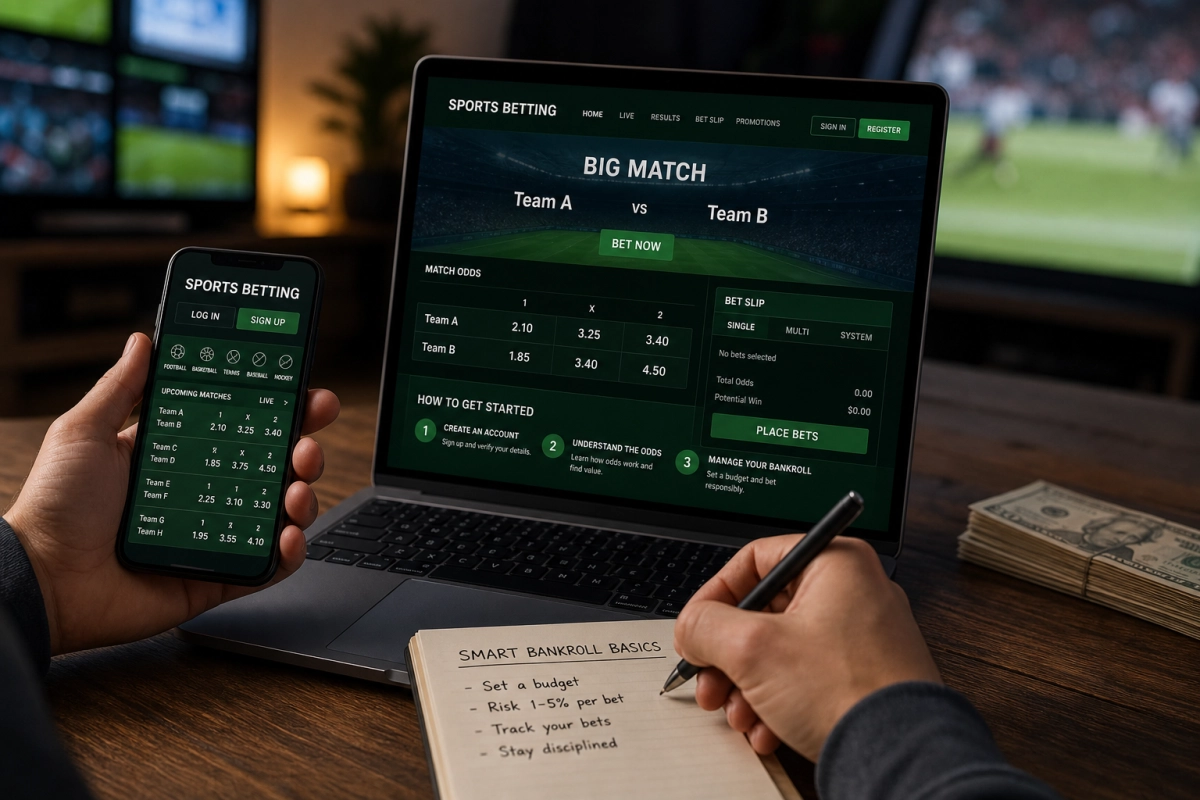
Sports betting for beginners — account setup and the basics of odds
Opening steps: create an account, verify identity, and set a bankroll
New bettors benefit from a simple, secure start. The typical account setup process requires an email, password, personal details, and identity verification (ID or proof of address). Reputable bookmakers also offer optional two-factor authentication and deposit limits. The goal should be to open an account safely and establish money rules before placing any wagers.
Practical checklist for account setup
- Choose a licensed bookmaker that lists sports of interest (football, basketball, tennis, etc.).
- Complete registration with accurate details; verify identity when prompted.
- Set deposit and loss limits during or immediately after signup.
- Test small deposits first (e.g., $10–$20) to learn the deposit/withdrawal process.
Simple bankroll rules beginners can follow
Bankroll management reduces emotional decisions. A common beginner rule is the flat-percentage method: stake 1–3% of the total bankroll on a single bet. For example, with a $500 bankroll, a 2% stake equals $10. This keeps losing runs manageable and preserves capital for learning.
- Conservative: 1% per bet — slower growth, lower risk.
- Moderate: 2% per bet — balanced approach for learning.
- Aggressive: 3% or more — higher volatility and risk; not recommended for beginners.
Understanding odds: decimal, fractional, and American formats
Odds express implied probability and determine payouts. Beginners should be comfortable reading three common formats: decimal, fractional, and American. Converting between them and calculating returns allows bettors to compare value across bookmakers.
Decimal odds (straight and simple)
Decimal odds show total return per unit staked. Example: 2.50 means a $10 bet returns $25 (profit $15). Implied probability = 1 / decimal. For 2.50 → 1 ÷ 2.50 = 0.40 = 40%.
Fractional odds (traditional, especially in UK)
Fractional odds show profit relative to stake. Example: 3/2 means profit of $3 for every $2 staked. A $10 bet at 3/2 returns $25 (stake + $15 profit). Convert to decimal: (numerator/denominator)+1 → (3/2)+1 = 2.5.
American odds (favours US market)
American odds use + or −. Positive (e.g., +150) shows profit on $100: $100 → $250 return ($150 profit). Negative (e.g., −200) shows stake needed to win $100: $200 stake → $300 return ($100 profit). Convert to implied probability using simple formulas depending on sign.
Quick example comparing formats
- Team A: Decimal 1.80 = Fractional 4/5 = American −125. A $20 bet returns $36 (profit $16).
- Team B: Decimal 2.20 = Fractional 6/5 = American +120. A $20 bet returns $44 (profit $24).
Understanding these formats allows beginners to compare prices, calculate potential returns, and judge implied probabilities. The next section explains common markets (moneyline, spread, totals, BTS), how to read lines for value, and step-by-step examples of placing pre-match and in-play bets.
Common betting markets — what each market means and realistic examples
Begin with the four markets most beginners encounter: moneyline (win/draw/win), spread (point handicap), totals (over/under), and Both Teams To Score (BTS). Below are short, practical definitions and realistic examples so you can visualise payouts and outcomes.
- Moneyline / 1X2 — A straight bet on who wins (or in soccer, where a draw is its own outcome). Example: Soccer — Team A 2.10 (decimal) vs Team B 3.40. A $10 moneyline bet on Team A at 2.10 returns $21 total (profit $11). If you expect Team A to win more than ~48% of the time (1 ÷ 2.10 = 47.6% implied), this might be value.
- Spread (handicap) — The bookmaker gives one side a points/goals handicap to balance the market. Example: NBA — Lakers −5.0 at 1.90 vs Nets +5.0 at 1.90. A $20 bet on Lakers −5 means the Lakers must win by 6+ points. The $20 returns $38 total if they cover (profit $18).
- Totals (over/under) — You bet whether the combined score will be over or under a line. Example: NFL total 44.5 at 1.95. A $15 bet on Over 44.5 returns $29.25 total if the teams score 45+ points (profit $14.25).
- Both Teams To Score (BTS) — Common in soccer; you bet whether both sides score at least once. Example: BTS Yes at 1.80, No at 2.00. A $12 bet on Yes at 1.80 returns $21.60 total (profit $9.60) if both teams score.
Reading lines, spotting value, and placing a pre-match bet — step-by-step
Learning to read a line for value is the most useful skill. The simple test: if your estimate of the true probability is higher than the implied probability from the odds, the bet has value. Use decimal odds to make this quick.
Step-by-step example
- Convert odds to implied probability: decimal 2.10 → 1 ÷ 2.10 = 47.6% implied.
- Make your estimate: after research you think Team A actually has a 55% chance to win.
- Compare: 55% (your estimate) > 47.6% (market) → you believe there is value.
- Size the stake using your bankroll rule: with a $500 bankroll and a 2% rule, stake = $10.
- Place the bet: select the market, enter $10, confirm potential return ($21 total), and submit. Record the bet in a simple spreadsheet (date, event, market, odds, stake, potential return).
Other practical tips: shop around with multiple bookmakers to find the best price (line shopping), check for market margins (books build in vig), and never bet more than your pre-set percentage even if you feel certain.
In-play betting basics and a live example
In-play markets move quickly and offer opportunities when lines shift after key events (goals, injuries, momentum). Treat them as higher-volatility bets: reduce stake size, be disciplined, and react to information rather than emotion.
Live example — basketball comeback value:
- Pre-game you avoided a bet. At halftime the underdog trails by 6 and the spread is now +8 (value compared to pre-game +5). You judge the favourite struggles with turnovers and the underdog historically posts strong second halves.
- Bankroll discipline: reduce to 1% for in-play risk. With a $500 bankroll stake = $5 at +8.0 line priced at 1.90. A $5 stake returns $9.50 if the underdog covers (profit $4.50).
- Place the in-play bet only after checking: team news (timeouts left, fouls), format (live limits often lower than pre-match), and whether the price genuinely reflects an advantage.
In-play can be profitable for disciplined bettors, but it magnifies the need for quick research, smaller stakes, and strict limits to avoid chasing losses. Keep records of pre-match vs in-play results to learn which approach suits your style.
Keeping records and reviewing your results
Make a habit of recording every wager so you can learn what works and what doesn’t. A simple log helps spot patterns, measure profitability, and keep emotions in check.
- What to record: date, event, market, bookmaker, odds, stake, result, and brief notes on why you placed the bet.
- How often to review: set a regular cadence (weekly or monthly) to check win rate, return on investment, and whether your staking rules are working.
- Use reviews to refine simple rules — adjust stake size, focus on markets you understand, and drop strategies that consistently underperform.
Responsible gambling habits to keep up
Protecting your wellbeing should be part of your routine. The best bettors know their limits and treat betting as controlled entertainment rather than a way to solve financial problems.
- Always use deposit, loss, and session limits offered by bookmakers.
- Take regular breaks; don’t chase losses or increase stakes after a losing run.
- If gambling starts to feel compulsory, step back and consider self-exclusion tools or professional support.
Getting started with confidence
Start small, stay curious, and keep discipline at the centre of every decision. Use the simple bankroll rules, log your bets, and view early weeks as practice rather than a race to profit. With time you’ll learn which markets suit you, how to spot genuine value, and how to make choices that match both your comfort with risk and your reasons for betting. Above all, prioritise safety and enjoyment: sensible limits and steady learning are the most reliable ways to improve and to keep the experience positive.