
 By Christian Hayes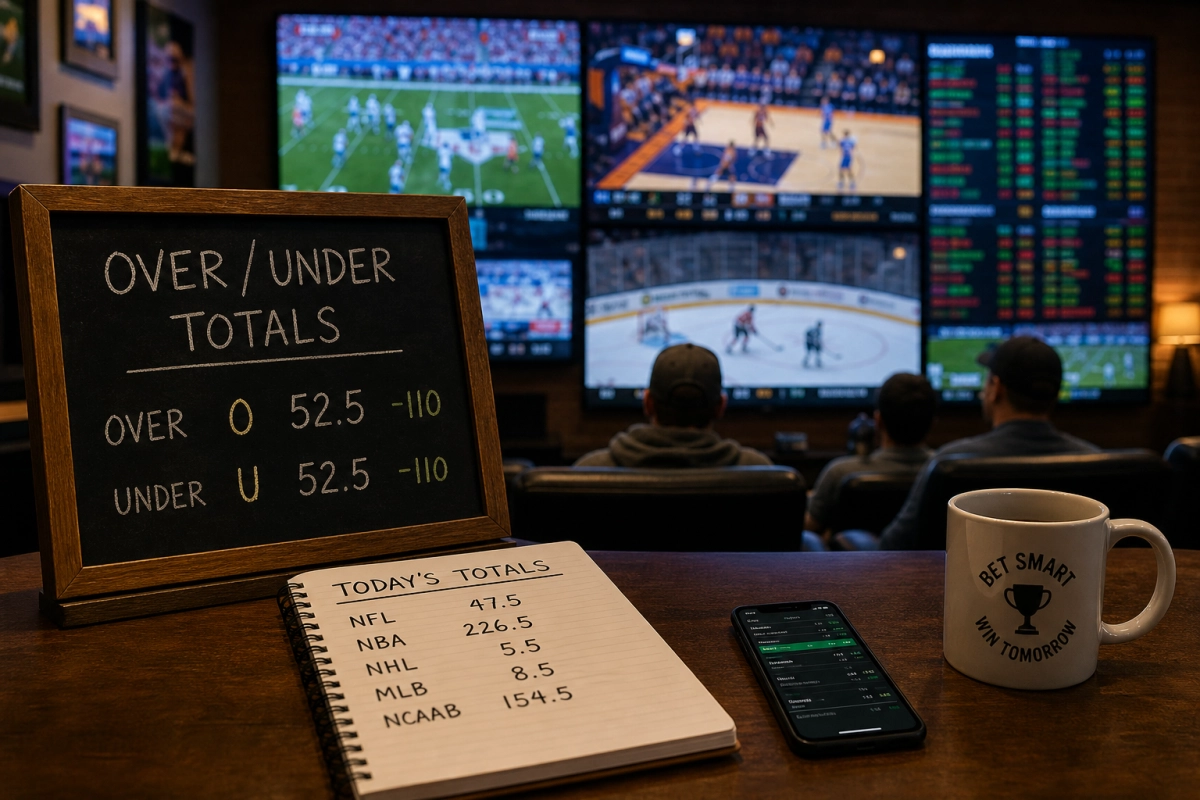
Why Over Under Betting Changes From Sport to Sport
Over under betting focuses on the combined score of a contest rather than which team or player wins. A sportsbook might set a football total at 2.5 goals, a basketball total at 224.5 points, or a hockey total at 6.5 goals. Bettors then choose whether the final combined score will finish above or below that line.
The basic idea is simple, but the analysis is not identical across sports. Scoring frequency, match duration, pace, playing surface, weather, substitutions, and overtime rules can all affect the result. A useful total assessment therefore begins with the sport’s scoring structure instead of treating every market as interchangeable.
For example, basketball creates many scoring opportunities through constant possessions, while football may produce relatively few goals and can be heavily influenced by one tactical decision. Tennis totals usually involve games or sets rather than points, and hockey totals depend strongly on goaltending, shot quality, and special teams. The same statistical approach cannot be applied accurately to all four sports.
How to Read a Total Line and Its Odds
A total line has two parts: the projected combined score and the price attached to each selection. If a basketball game carries an over/under line of 218.5 at approximately -110, the over wins if both teams score at least 219 points, while the under wins at 218 points or fewer. Decimal or fractional odds may display the same market differently, but the underlying settlement remains similar.
Half-point totals are common because they remove the possibility of an exact tie. A whole-number line, such as 6.0 goals, can produce a push if exactly six goals are scored. In that case, the original stake is generally returned, although each sportsbook’s rules should be checked before placing a bet.
Sportsbooks may also offer related markets, including:
- Alternate totals: A higher or lower line with a different price, such as 215.5 or 221.5 points.
- Team totals: A wager on one team’s score rather than the combined score.
- Period or segment totals: Markets covering a quarter, half, period, set, or individual inning.
These options can provide more specific analysis, but they also create additional risks. A team total may be affected by foul trouble or an injury to one scorer, while a first-period hockey total can be decided by a short burst of early pressure. Lower-scoring sports also make individual events more significant, so a single goal or break of serve can move the market sharply.
Comparing Pace, Scoring, and Match Duration
Sport-specific statistics are essential when assessing whether a line appears high or low. Basketball bettors often examine possessions per game, offensive efficiency, defensive efficiency, transition frequency, and rest. Football analysis may focus on expected goals, shots, field position, finishing rates, and the likelihood of a cautious game state.
Hockey totals require attention to expected starting goaltenders, shots conceded, power-play opportunities, penalty-killing performance, and empty-net tendencies. Tennis bettors may study service-hold rates, break-point conversion, tiebreak frequency, surface, and whether the match is best of three or best of five sets.
Match duration also matters. A regulation basketball total may be very different from a college or international line because playing time and pace differ. Baseball includes innings rather than a clock, while football can move into extra time or penalties. Before comparing trends, bettors should confirm that the samples use the same competition format and settlement definition.
Those differences lead directly to the next stage of analysis: examining conditions, overtime, weather, surface, and the sportsbook’s specific rules before interpreting any total.
How Weather, Surface, and Venue Conditions Shift Totals
External conditions can change a total without producing an obvious change in team quality. In outdoor football, strong wind can reduce passing accuracy, disrupt long kicks, and encourage shorter possessions. Heavy rain may slow the surface and increase handling errors, although it can also create defensive mistakes. The effect is not automatically an under, so bettors should consider whether the conditions are likely to reduce scoring chances or simply make individual errors more probable.
Surface is particularly important in tennis. Clay generally slows the ball and creates more rallies, while grass can reward first-strike serving and produce shorter points. Hard courts sit between those broad descriptions, but speed varies by venue. A player’s overall service or break statistics may therefore hide a meaningful surface-specific difference. In baseball, wind direction, temperature, humidity, and the dimensions of the ballpark can influence carry and run production. A total based on a neutral venue may not translate accurately to a hitter-friendly or pitcher-friendly park.
Indoor venues remove some weather uncertainty, but they do not eliminate environmental factors. Altitude can affect ball flight and player fatigue, while travel, rest, and unusual court or rink conditions may influence pace. These details should be treated as adjustments to a statistical baseline rather than as standalone reasons to bet one side.
Overtime and Extra-Period Rules Can Decide the Settlement
Before comparing a total with historical results, confirm whether overtime counts. Basketball totals commonly include all overtime periods, meaning a game tied after regulation can produce a substantial late scoring increase. Football rules vary by competition and sportsbook: some markets include extra time, while others settle on the regulation result only. Soccer totals generally exclude extra time unless the market specifically states otherwise.
Hockey presents another important distinction. A regulation total may be settled using the score after 60 minutes, while a full-game total may include overtime but exclude a shootout goal, or treat the shootout according to a separate rule. Baseball can also require special attention to suspended games, postponed contests, and whether a game must reach a minimum number of innings to become official.
These differences make identical-looking numbers potentially incomparable. A bettor who uses a team’s average full-game score against a regulation-only line may be adding scoring that the sportsbook will never count. The market description, grading policy, and any listed minimum playing requirement should be checked before placing the wager.
Using Market Context Without Treating Trends as Proof
A practical assessment starts by estimating a reasonable scoring range rather than searching for a guaranteed outcome. Compare the posted line with relevant averages, recent pace, opponent-adjusted efficiency, injuries, expected lineups, and the conditions expected on the day. Recent results can provide useful information, but a small sample may be distorted by overtime, unusually high shooting, red cards, empty-net goals, or weak opponents.
One common mistake is assuming that a sequence of overs or unders must soon reverse. Another is relying on league-wide averages without accounting for the teams, venue, competition format, and current personnel involved. Bettors can also overlook line movement: a total that opened at 219.5 and moved to 222.5 may reflect injury news or respected market opinion, but movement alone does not establish the correct side.
Finally, verify how postponed events, abandoned matches, player withdrawals, and overtime are handled. Settlement rules can matter as much as the statistical projection, particularly in low-scoring sports where one counted or excluded event can determine the result.
Making More Disciplined Total-Market Decisions
Over under betting is most useful when treated as a comparison between a posted number and a carefully considered scoring expectation. The strongest process is not about finding certainty, but about identifying whether the available price and line adequately reflect the relevant circumstances.
Keep the analysis specific to the sport, competition, and market being assessed. Check the rules before relying on historical data, account for meaningful changes in conditions or personnel, and avoid allowing recent streaks or familiar narratives to replace sound reasoning. When the evidence is unclear, passing on the market is also a valid decision.
No projection can remove the randomness inherent in sport. A missed chance, late penalty, change in weather, injury, or overtime period can alter the final result. Responsible analysis therefore depends on realistic expectations, consistent comparisons, and sensible staking rather than treating any total as guaranteed.