
 By Christian Hayes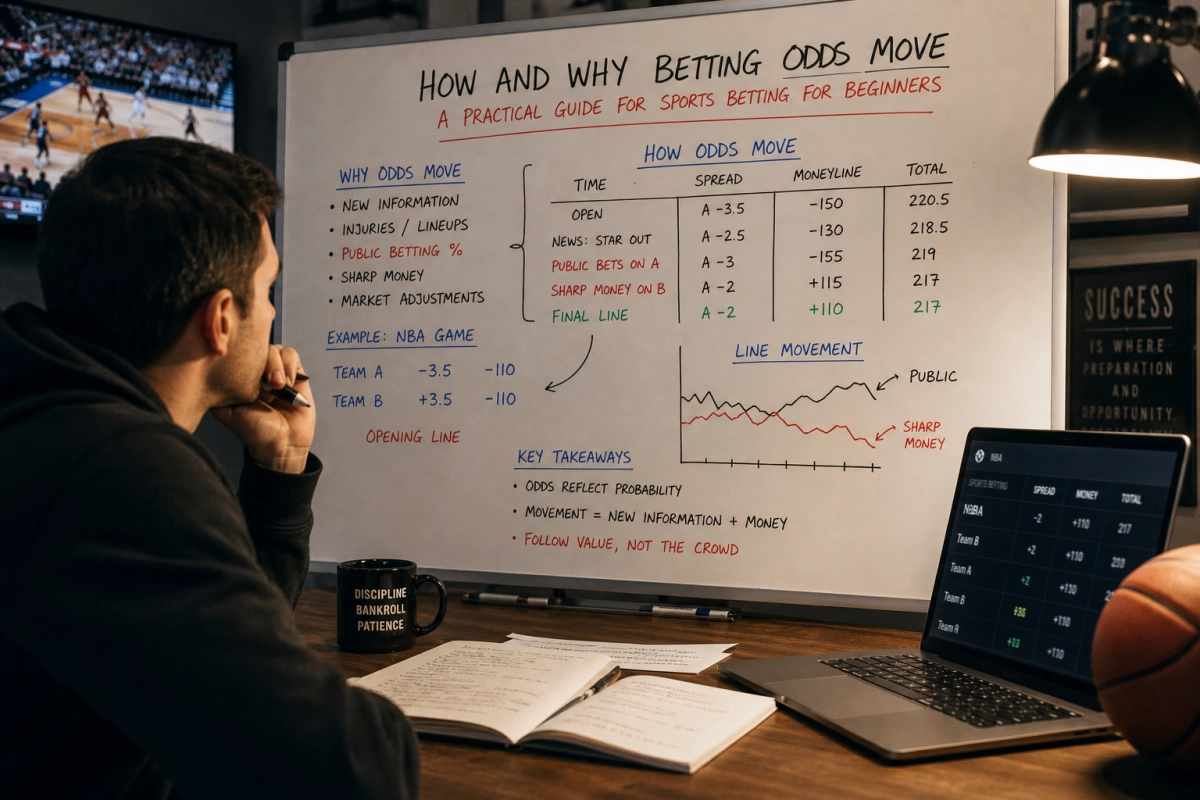
How odds move and what bettors should read from the market
Odds change for a reason. Understanding why odds move and how to tell sharp (professional) money from public bets is a core skill in sports betting for beginners. This part explains the main drivers behind movement, common patterns you will see across football, basketball and tennis markets, and straightforward reactions a beginner can use before a match and while games are live.
Primary reasons odds shift — supply, information and liability
Bookmakers balance two forces: their liability (how much they stand to lose) and the information arriving about the event. The common causes of movement are:
- New information: team news, injuries, weather, starting lineups. Example: a striker ruled out two hours before kickoff can push a football team’s odds from 1.80 to 2.20.
- Sharp action: large, well-timed bets by professional bettors or syndicates. Books often move quickly to limit exposure.
- Public sentiment: many small recreational bets on one side (often favorites or popular teams) can slowly skew odds.
- Bookmaker adjustments: algorithmic updates or traders reacting to correlated markets (e.g., a heavy moneyline bet can shift handicaps and totals).
Distinguishing sharp money from public money and typical movement patterns
Not all movement is equal. Learning basic signals helps separate professional influence from crowd bias.
Sharp-money indicators
- Early, sudden line change: large move soon after the market opens — often a sharp. Example: an NBA point spread moves -3 to -6 within hours of release; this suggests a pro-side bet, especially if it’s accompanied by limited price availability (low maximum stakes) at the old line.
- Line tightening across books: multiple bookmakers mirror the same direction quickly — professionals often force this by attacking best-priced books.
- Closing line drift with value preserved: sharp bettors aim for better prices early; if a later bettor still finds value after movement it’s less likely sharp.
Public-money indicators
- Slow drift toward a popular team: favourite shortens gradually as small stakes pour in (typical before major football matches when casual bettors back the big club).
- Totals or “both teams to score” inflations: recreational bettors chasing high-scoring outcomes push totals up in football or basketball.
- Line moves late with lots of volume but no cross-book pattern: often a sign of mass public betting rather than informed pros.
Practical beginner responses (pre-match): shop for the best price, watch line history for sudden early movement, and avoid overreacting to slow public drift. In-play, prioritize markets that lag real-time events (e.g., tennis live games or basketball second-quarter spreads) and size stakes proportionally — smaller and quicker for in-play.
Part 2 will break these signals into step-by-step checks, show concrete pre-match and live examples in football, basketball and tennis, and explain how to act on sharp vs public movement in practical bets for sports betting for beginners.
A step-by-step pre-match checklist for spotting sharp vs public movement
Before you place a pre-match bet, run this quick checklist in order. It’s a fast routine you can do in under five minutes and it separates noisy public movement from informed sharp action.
- Check timing: Did the move happen immediately after market open or right before kickoff? Early, sudden moves are more likely sharp; slow erosion toward a favourite close to start is usually public.
- Compare books: Look at 3–5 bookmakers and one exchange. If several books move the same way quickly, that’s a sharper signal than one book drifting alone.
- Watch availability: Can you still get the old price? If max stakes are tiny or the old line is removed, shops are limiting risk — sharp money likely hit that price.
- Check related markets: Did totals, corners, or Asian lines move too? Correlated adjustments (e.g., moneyline and handicap both shifting) suggest information-driven bets, not casual punts.
- Scan news feeds: Any late injuries, weather updates or team-sheet changes? If yes, the move may be informational rather than betting-driven.
- Assess magnitude: A half-goal or 0.5-point change is different from a 1+ goal/point swing. Bigger swings without news are often sharp.
- Decide action: If evidence leans sharp and you have access to a still-good price, take it. If evidence points to public bias or you missed the price, avoid chasing.
Concrete live examples — what to do in football, basketball and tennis
Real scenarios make the checklist actionable. Below are common in-play situations and clear responses beginners can apply.
- Football (soccer) — early goal changes momentum: Imagine a 0–0 game where the away underdog scores in minute 20. Pre-match favourites’ odds blow out (1.85 → 2.40) and totals fall slightly. If the market’s slow to reflect the away team’s form and you see exchange backing for the away side, consider a small live bet on the away win or lay the favourite. Stake smaller than your usual pre-match size (0.5–1% bankroll) — live volatility is high.
- Basketball (NBA) — sudden spread move at open: A game opens at -3 for Team A and within hours moves to -6 on multiple books with limited liability at -3. That’s a classic sharp move. If you grabbed -3 early, hold the position. If you didn’t, don’t chase -6; instead look for correlated value — e.g., player props tied to Team A’s pace may be underpriced before lines catch up. If the sharp move happens in-play (first quarter momentum), place smaller, quicker bets (0.5–1% bankroll) on spreads or totals that lag live scoring.
- Tennis — break-of-serve and lagging markets: Player A breaks to lead 3–1 in set two. Bookmakers sometimes are slow to adjust set/winner lines for immediate momentum swings. If exchange prices show heavy back volume for Player A but book prices remain long, there’s value to take a live back on Player A to win the set or match. Use very small stakes and a tight exit plan — hedge if odds shorten quickly or if serve returns to a dominant server.
Across all sports, your default responses: (1) take early sharp value if available and you have conviction; (2) avoid chasing slow public drift; (3) size down and be decisive live — quick small bets beat large uncertain ones. Practicing these examples will sharpen your market reading and reduce costly emotional reactions.
Putting the market-reading routine into action
Reading odds and responding correctly is a practical skill you build by doing — not just by reading. Treat the market like any other analytical tool: start small, keep objective records, and let results guide adjustments. Prioritise discipline (bankroll rules, unit sizing), information hygiene (reliable sources, line history), and patience. Over time you’ll recognise patterns faster, reduce emotional reactions, and find where your edge — if any — is strongest.
A simple beginner’s action plan (do this week)
- Set a clear bankroll and define a unit size (e.g., 1% per pre-match bet, 0.5% for in-play).
- Open accounts at 2–4 bookmakers plus one exchange so you can shop prices and see market depth.
- Pick one sport to focus on and follow line movements for 10–20 matches without betting to learn typical patterns.
- Use the pre-match checklist each time: timing, cross-book comparison, availability, related markets, and news check.
- When you bet live, limit stake size, set a stop-loss or hedge plan in advance, and be prepared to exit quickly.
- Record every bet (market, odds when placed, size, closing odds) and review weekly; track closing-line value as feedback.
Final notes
Odds movement is information — sometimes noisy, sometimes valuable. Your job is to filter noise, protect your bankroll, and act decisively when signals line up. Keep learning, stay humble, and remember that small, consistent improvements in reading the market will outpace occasional lucky wins. Bet responsibly and treat your market-reading practice as the ongoing project it is.