
 By Christian Hayes
How live betting changes the way you read odds
When you switch from pre-match betting to live (in-play) markets, the betting landscape shifts from static pricing to a constantly moving market. You’ll no longer be looking at a single snapshot of probability; instead, you’re interpreting a stream of updated prices that reflect what’s happening in real time. That means speed, context, and mental models matter: a goal, red card, or injury can swing an outcome and the odds in seconds.
In-play odds combine several inputs you should watch: the bookmaker’s real-time assessment, how much money is being matched on each side (liquidity), and market sentiment from other bettors. Because prices move so quickly, your focus should be on understanding what each price represents (the implied probability) and whether it represents value given the match state. You’ll also need to be comfortable making quick decisions and using stop-loss discipline if you trade positions rather than simply place single bets.
Reading live odds: formats, implied probability, and core in-play markets
Odds formats and the quick math you’ll use
Odds appear in three common formats: decimal (e.g., 2.50), fractional (5/2), and American (+150 / -200). For live betting, decimal is the most straightforward because it lets you compute implied probability instantly: implied probability (%) = (1 / decimal odds) × 100. For example, odds of 2.50 imply a 40% chance (1 / 2.50 = 0.40 → 40%).
If you see American or fractional odds, convert them to decimal first so you can compare markets quickly. Fractional 5/2 equals 3.50 decimal; American +150 equals 2.50 decimal. Once you’re comfortable converting, you’ll be able to judge whether the market’s price tracks the match events or if it’s lagging behind—often where opportunity lies.
Common in-play markets and what the odds tell you
- Match winner / Moneyline: The simplest live market; odds change with score and momentum. A late equalizer will rapidly shorten the trailing team’s odds.
- Next event (goal, corner, card): Short time horizons and fast price moves. These markets reflect immediate event probabilities and are sensitive to field position and player substitutions.
- Total goals / Over-Under: Adjusts when clear chances appear or when tempo changes (e.g., a team defending a lead).
- Handicap / Spread: Used when one side dominates; live handicaps balance the market so odds remain competitive.
By combining quick conversion skills with an eye for market type and match context, you’ll start to see why some live prices are fair and others are exploitable. Next, you’ll learn how real-time events and bookmaker algorithms drive odds adjustments and how to spot genuine value during the game.
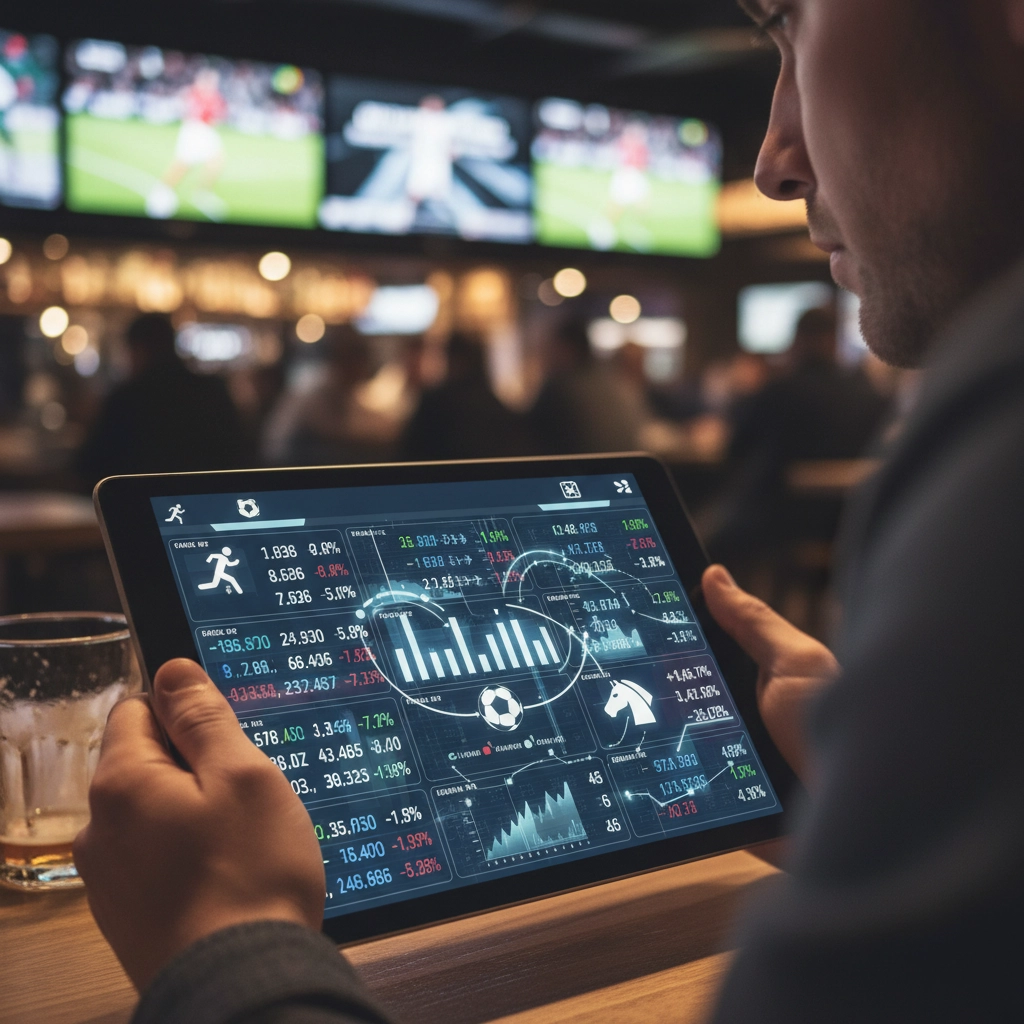
What moves live odds: algorithms, liquidity and market flow
Live prices aren’t magic — they’re the output of models, money and human behaviour working together. Bookmakers feed live-event data (score, time, possession, shots, substitutions) into pricing algorithms that re-calculate outcome probabilities every second. Those models factor in sport-specific dynamics (for football, expected goals and game state; for tennis, serve advantage and momentum) and the bookmaker’s desired margin. When those recalculated probabilities diverge from the current market price, the odds shift.
Liquidity and matched money amplify or dampen those moves. On exchanges, large matched bets create visible pressure and move the market; on sportsbook books, sharp action from professional bettors can prompt the operator to shorten or suspend a market to control liability. Low-liquidity markets (lower tiers, niche competitions, small-value props) tend to have wider swings and bigger gaps between fair value and offered odds — both a risk and an opportunity. Finally, market flow and sentiment matter: bettors tend to herd after visible events, sometimes causing overreactions that quickly correct, which is where value hunters profit.
Tactics for finding value and managing positions in-play
Value in-play comes from two places: superior information/interpretation and faster reaction. If your read of the match (or a quick statistical indicator like a spike in expected goals) implies a different probability than the current odds, you may have an edge. Common tactics include:
- Play the lag: After a major event (goal, red card), markets often over-adjust for a few seconds. Quick, disciplined action can capture mispricings before algorithms recalibrate.
- Scalping small spreads: Backing then laying (or vice versa) at slightly improved prices to lock small, repeatable profits—best on exchanges with depth.
- Hedging and cash-out: When a pre-match bet turns at-risk, partial hedges or cash-outs can lock profit or trim loss; use them with clear rules to avoid indecision.
Risk management matters more in-play than pre-match. Use smaller stakes or a fraction of your usual unit when volatility is high. Define entry and exit criteria before placing a trade: at what price or event will you take profit, and what is your stop-loss? Consider using a simplified Kelly fraction or fixed-percentage staking to avoid ruin from streaks. Crucially, don’t chase “revenge bets” after a loss — live betting magnifies emotional mistakes.
Practical tools and disciplines for live bettors
Successful in-play bettors combine the right tools with strict discipline. Useful tools include fast live stats (xG, shot maps, pressure metrics), multi-book odds comparison, tick charts that show price movement, and a reliable streaming feed to remove broadcast delay guesswork. If you use an exchange, monitor market depth to judge how much you can size your position without moving the price.
Set a pre-match and in-play checklist: watchlist of players/events, entry triggers, maximum exposure per market, and exit rules. Keep a trading log—record prices, reasons for the bet, and outcomes—to refine pattern recognition. Finally, respect latency and limits: your ISP, bookmaker delay and streaming lag can turn a perceived edge into a loss. Combine fast data, clear rules and disciplined staking, and you’ll turn raw odds movements into repeatable opportunities rather than roulette spins.

Putting live betting into practice
Ready to move from theory to doing? Start deliberately: pick a single sport and one or two in-play markets (for example, match winner and next goal), set strict unit sizes, and run small, timed sessions where your only goal is to apply one tactic (play the lag, scalp, or hedge). Track every decision in a simple log: market, odds in/out, reason, and outcome. Over a few dozen trades you’ll see which signals and rules actually work for you.
- Observe first: watch live markets without betting to learn typical price reactions.
- Paper trade: record hypothetical trades to test entry/exit rules without risk.
- Gradually scale: increase stake only after consistent positive edge appears.
- Use one reliable data source and one odds comparison tool to avoid confusion.
For practicing with real-time markets and market depth, consider experimenting on an exchange such as Betfair Exchange, where you can see matched money and practise laying and backing at granular prices. Keep your sessions short, stick to your rules, and treat each trade as a learning opportunity.
Frequently Asked Questions
How do I quickly convert live decimal odds into implied probability?
Use the simple formula: implied probability (%) = (1 / decimal odds) × 100. Decimal odds are fastest for in-play markets because the math is immediate—e.g., 2.50 → 1/2.50 = 0.40 → 40% chance.
Which tools give the biggest advantage when live betting?
High-frequency live stats (xG, shots on target, pressure metrics), a fast streaming feed to avoid broadcast delay, and a multi-book odds comparison or exchange view for market depth provide the biggest practical edge. Tick charts or price history help identify short-term momentum and overreactions.
What are the best risk-management rules for in-play betting?
Use smaller stake sizes than pre-match, set predefined entry and exit criteria, apply stop-loss or hedging thresholds, and keep a trading log. Avoid increasing stakes after losses and limit exposure per market to a fixed percentage of your bankroll.